
USCIS Doubles Down on “Discretion and Administrative Grace”: What the May 21, 2026 Policy Memo Means for Adjustment of Status
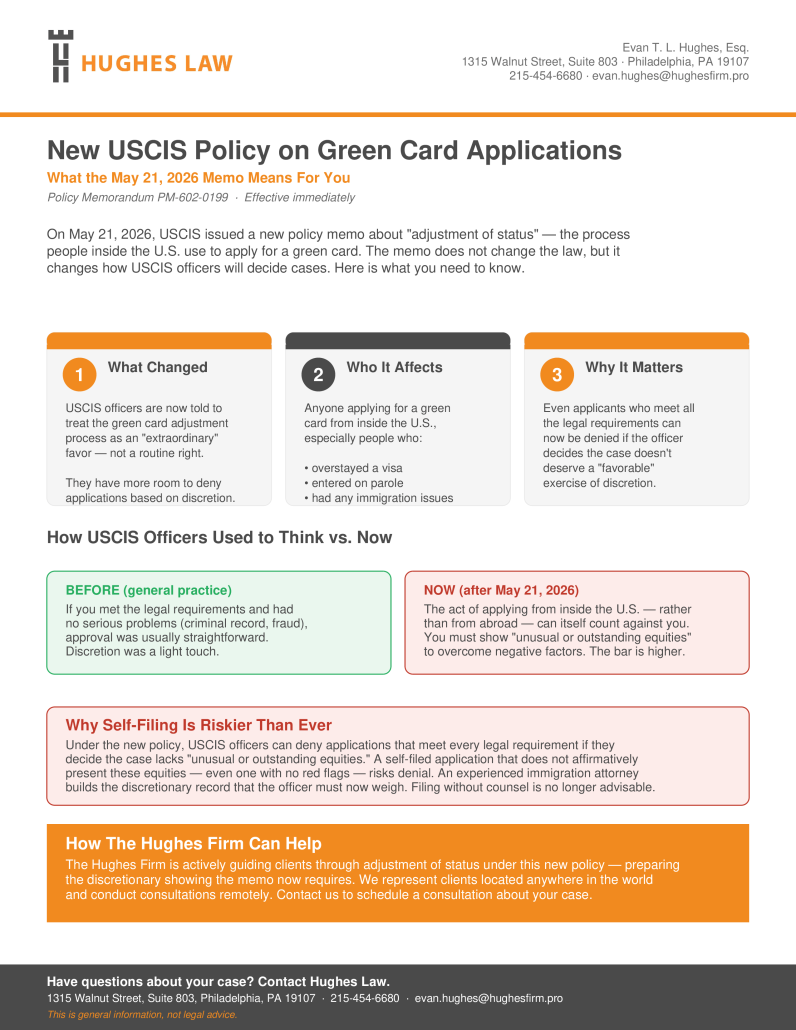
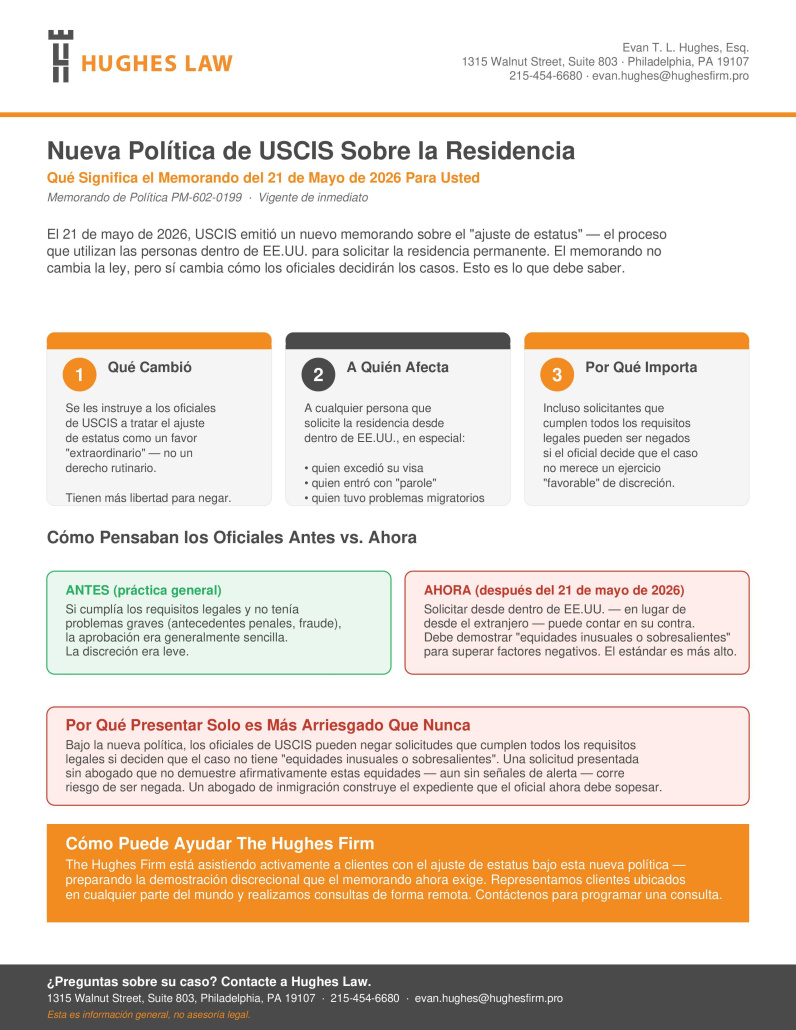
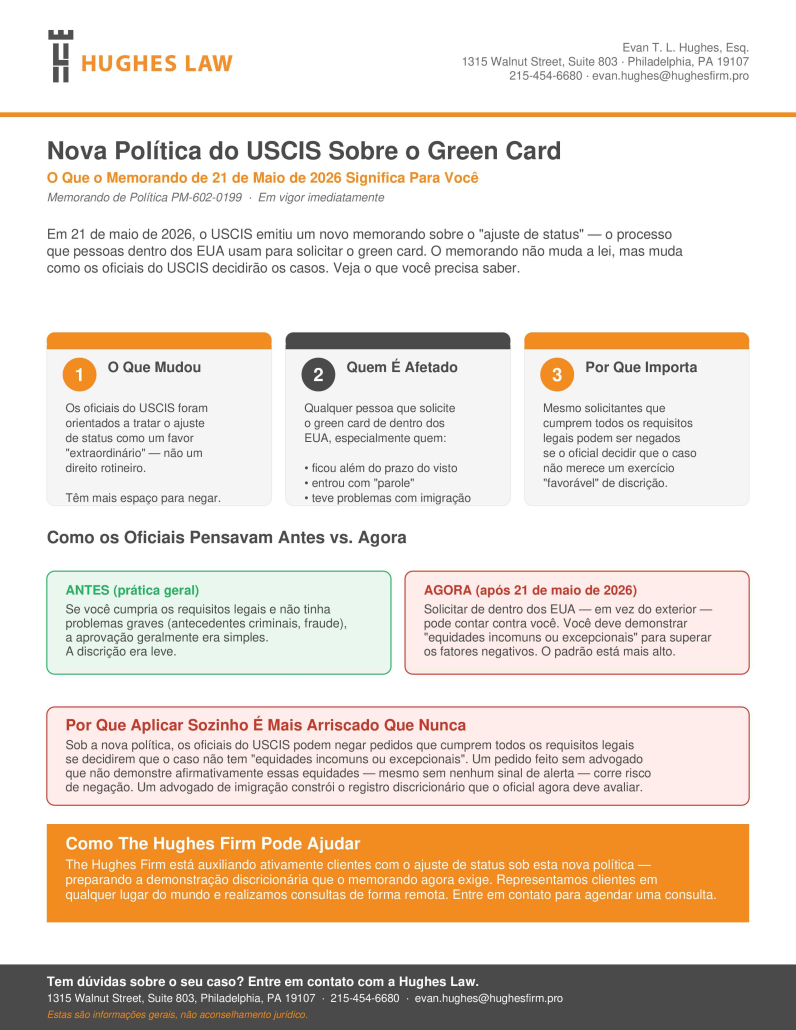
On May 21, 2026, USCIS issued Policy Memorandum PM-602-0199, a document with a title that reads more like a sermon than a policy directive: “Adjustment of Status is a Matter of Discretion and Administrative Grace, and an Extraordinary Relief that Permits Applicants to Dispense with the Ordinary Consular Visa Process.” The memo does not change any statute. It does not amend a regulation. It does not, on its face, alter eligibility for adjustment under INA § 245. But to read it that way is to miss the point. PM-602-0199 is a signal — to adjudicators, to the immigration bar, and to applicants — that the discretionary lever built into § 245(a) is about to be pulled harder and more often than it has been in many years.
What the Memo Actually Says
The memo restates a proposition no immigration lawyer would dispute: that adjustment of status under INA § 245(a) is a discretionary form of relief. It marshals a long string of authorities — Matter of Blas, 15 I&N Dec. 626 (BIA 1974); Patel v. Garland, 596 U.S. 328 (2022); Elkins v. Moreno, 435 U.S. 647 (1978); Santos-Zacaria v. Garland, 598 U.S. 411 (2023); and a small mountain of circuit court decisions — for the proposition that adjustment is “extraordinary” relief and a “matter of grace, not right.”
USCIS then layers on a second theme: that adjustment “was not designed to supersede the regular consular visa-issuing process.” Drawing on Chen v. Foley, 385 F.2d 929 (6th Cir. 1967), and Matter of Tanahan, 18 I. & N. Dec. 339 (BIA 1981), the agency frames § 245 as a narrow detour from what Congress supposedly intended to be the default path — consular processing abroad. The implicit hierarchy is unmistakable: consular processing is normal; adjustment is exceptional.
From there, the memo moves to its operational core. Officers are instructed that when consular processing is available to an applicant, they must “consider the consistent understanding of the courts and the BIA that adjustment of status is an extraordinary discretionary relief.” Officers are reminded to weigh “all relevant factors and information in the totality of the circumstances,” including immigration violations, prior fraud or misrepresentation, conduct inconsistent with the purpose of nonimmigrant admission or parole, and — perhaps most strikingly — “an alien’s failure to depart as expected” when the purpose of admission has been fulfilled.
The memo also invokes Matter of Blas’s requirement that adverse factors may need “to be offset … by a showing of unusual or even outstanding equities,” and emphasizes that “the absence of adverse factors, by itself, does not demonstrate such unusual or outstanding equities.”
Why This Memo Matters Even Though It Changes No Law
Discretion is not new. The statute has always said “may be adjusted.” Matter of Blas has been on the books for over fifty years. What is new is the framing, and framing in administrative law matters more than non-practitioners often appreciate.
For a generation, USCIS adjudicated most adjustment applications as essentially eligibility-driven decisions. If the applicant cleared the statutory bars — § 245(c), inadmissibility grounds under § 212(a), the priority date — discretion was treated as a light touch, exercised against the applicant only where the record contained genuinely serious adverse equities such as criminal history, fraud, or national security concerns. The discretionary analysis was real, but it rarely functioned as an independent obstacle for an applicant with a clean record and a qualifying petition.
PM-602-0199 inverts the default. By emphasizing that adjustment “permits the alien applicant to avoid the prescribed, ordinary consular visa process,” and by characterizing the use of adjustment — rather than any underlying misconduct — as itself a contravention of “Congressional expectations,” the memo invites officers to treat the very act of seeking adjustment as a factor weighing against the applicant when consular processing is available. The memo states this almost openly: an applicant’s “attempt to avoid the ordinary consular immigrant visa process, usually accompanied by their violation of our immigration laws, are adverse factors that the [applicant] may need ‘to offset … by a showing of unusual or even outstanding equities.'”
That is a meaningful shift. Under the prior operational understanding, an applicant who had overstayed a visa but had an approved I-130 from a U.S. citizen spouse, no criminal history, U.S.-citizen children, and steady employment was an unremarkable approval. Under the framing of PM-602-0199, that same applicant has affirmatively engaged in conduct — the overstay plus the choice to adjust rather than depart and consular process — that constitutes an adverse factor requiring offset by “unusual or even outstanding equities.” Family ties and good moral character, the memo emphasizes, are not enough on their own.
The Dual-Intent Carveout and Its Limits
The memo acknowledges what it has to acknowledge: that nonimmigrants in dual-intent categories — principally H-1B and L-1 holders — are not violating Congressional expectations when they pursue adjustment. But it then immediately limits the carveout: “maintaining lawful status in a dual intent nonimmigrant category is not sufficient, on its own, to warrant a favorable exercise of discretion.”
The signal here is subtle but important. Dual intent protects against the inference of adverse conduct from the act of adjusting itself. It does not, in USCIS’s view, supply affirmative equities. An H-1B applicant with an approved I-140 still must persuade the officer that approval is warranted on a totality-of-circumstances analysis — and the officer’s analytic baseline has just been tilted.
What the Memo Leaves Unresolved
Several things in PM-602-0199 are conspicuously undefined, and the absence of definition is itself a planning problem.
First, the memo never specifies what “unusual or even outstanding equities” actually look like in 2026. Matter of Blas itself was a deportation case from another era, and the BIA’s discretionary jurisprudence has evolved unevenly. The memo invokes the standard without operationalizing it, leaving officers — and applicants — to guess.
Second, the memo notes that USCIS “may provide policy guidance specific to certain adjustment of status categories or discrete populations of aliens.” That sentence should be read as a promise of follow-on memoranda. Practitioners should expect category-specific guidance — likely targeting employment-based filings, parole-based adjustments, and possibly even some family-based categories — in the months ahead.
Third, the memo’s treatment of parolees is striking. By repeatedly grouping parolees with nonimmigrant overstays as people who have failed to “depart as expected,” the memo elides categories of parolees who were affirmatively invited to the United States under public-benefit or humanitarian parole programs. Whether that grouping will be applied uniformly, or whether certain parole populations will be treated differently in promised follow-on guidance, remains to be seen.
Fourth, the memo’s “Use” section contains the customary disclaimer that the policy “may not be relied upon to create any right or benefit.” That language is standard, but it cuts in a particular direction here: it limits the memo’s utility as a tool for applicants in litigation while preserving its full force as a directive to adjudicators.
Practical Implications for Practitioners
A few takeaways for those of us who practice in this area.
The discretionary section of the adjustment application — historically a perfunctory exercise — now requires real attention. Applicants should be prepared, where adverse factors exist, to affirmatively document equities: length of residence, family ties to U.S. citizens and lawful permanent residents, employment history, tax compliance, community involvement, hardship to qualifying relatives, contributions to the U.S. economy, and any other facts that elevate the case beyond a baseline showing. The memo essentially invites practitioners to brief discretion the way one would brief a cancellation of removal application.
Denials based on discretion will require, per the memo itself, a written analysis of the positive and negative factors. That requirement, grounded in 8 CFR § 103.3(a)(1)(i), is one of the few real procedural protections in the memo and one practitioners should hold USCIS to. A denial notice that recites the conclusion without articulating the balancing analysis is reviewable on motion to reopen or reconsider and is a building block for any subsequent litigation.
The interaction between PM-602-0199 and Patel v. Garland deserves close attention. Patel held that federal courts lack jurisdiction to review factual determinations underlying discretionary denials of adjustment. USCIS cites Patel approvingly in the memo. The combination — broad discretion at the agency, narrow review in the courts — should focus practitioner effort on the front end of the case rather than on litigation after the fact. Building the record before the officer rules is now the entire game in most cases.
Finally, the memo’s emphasis on consular processing as the “ordinary” path should prompt a sober conversation in some cases about whether adjustment remains the right strategic choice. For applicants with clean records and no inadmissibility issues, consular processing was always an option; for some categories of applicants, it may now be the safer one, notwithstanding the disruption and family separation it entails. That is a case-by-case judgment that turns on the specifics of inadmissibility, prior immigration history, and the applicant’s circumstances.
Closing Thought
PM-602-0199 does not, by its own terms, change the law. It is a memorandum about how to read the law USCIS already administers. But anyone who has practiced immigration law long enough knows that the gap between the statute and the way the statute is administered is where most cases are actually won or lost. This memo widens that gap and tilts it. The bar will need to respond accordingly — with more thorough discretionary briefing, more careful client counseling about the choice between adjustment and consular processing, and a renewed willingness to challenge denials that fail to comply with the memo’s own requirement of a reasoned, on-the-record discretionary analysis.
Resources
Nothing in this post is legal advice. Each immigration matter turns on its own facts. If you have questions about how PM-602-0199 may affect your case or your client’s case, contact a qualified immigration attorney.

